


eBay Product Research Strategy
Without a strong eBay product research strategy, long term success is not possible. Simply listing random products or copying someone else’s store is not a sustainable approach. A strategy means researching in a structured way and making every decision based on data. The first step is keyword selection. You should choose keywords that are either broad, such as “kitchen tools”, or niche specific, such as “portable blender”. Broad keywords help you explore the market, while niche keywords help you identify exact opportunities.
After that comes demand validation. Check sold listings in Seller Hub. This shows how many times a product has been sold. If a product is selling consistently, it is a clear indicator of demand. A one time sale is not important, consistency is what matters.
The next step is competition analysis. Check active listings. This shows how many sellers are selling the same product. If the competition is very high, it becomes difficult to stand out. But if demand is high and the number of sellers is relatively low, the chances of entering the market are strong.
Pricing analysis is equally important. Look at the average price and calculate whether you can source the product at that price and still make a profit. Just looking at the selling price is not enough, you also need to consider costs, shipping and fees.
Finally, do trend analysis. The trend graph shows whether interest in a product is increasing or decreasing over time. Products with a rising trend are the best, while products with a declining trend are risky.
An effective strategy is one that can be repeated. If you follow the same process for every product, keyword, demand, competition, pricing and trend, you will gradually start making better decisions.
Best eBay Product Research Methods
Different sellers use different eBay product research methods, but the ones that work consistently are mostly data driven. Here are some practical methods you can use. The most common method is sold listings analysis. In this, you directly check which products are already selling. This method is reliable because it is based on real buyer behavior. You can easily identify which items are in demand.
The second method is competitor tracking. Identify top sellers and observe their listings. You get insights into what types of products they are selling, at what price, and which products appear repeatedly. This method helps you find proven products.
The third method is niche based research. In this, you choose a specific category such as “home and kitchen” or “fitness accessories” and identify the best performing products within that category. This method is safer for beginners because you are working within a focused area.
Another effective method is trend based research. In this, you identify rising products that are becoming popular. However, this method also carries risk because not every trend is profitable in the long run.
There is one practical challenge here, manual research is time consuming. Checking each listing individually, comparing data, and taking notes is a slow process. This is where using tools becomes helpful. Once you set up your research in Seller Hub and apply filters, you can use a Chrome extension to speed up the process. It helps you review data quickly and reduces repetitive work. These types of tools are commonly searched as eBay seller hub product research tools or eBay seller hub scraper tools because they streamline the research workflow.
The best method is the one you can follow consistently. Whether you use sold listings analysis, competitor tracking, or niche research, if you focus on data and repeat the same process, you will gradually learn how to identify winning products.
Step-by-Step Execution (Exact Workflow)
By now you understand the strategy, but the real game is in execution. If you want to consistently find winning products, you need to follow a fixed workflow.
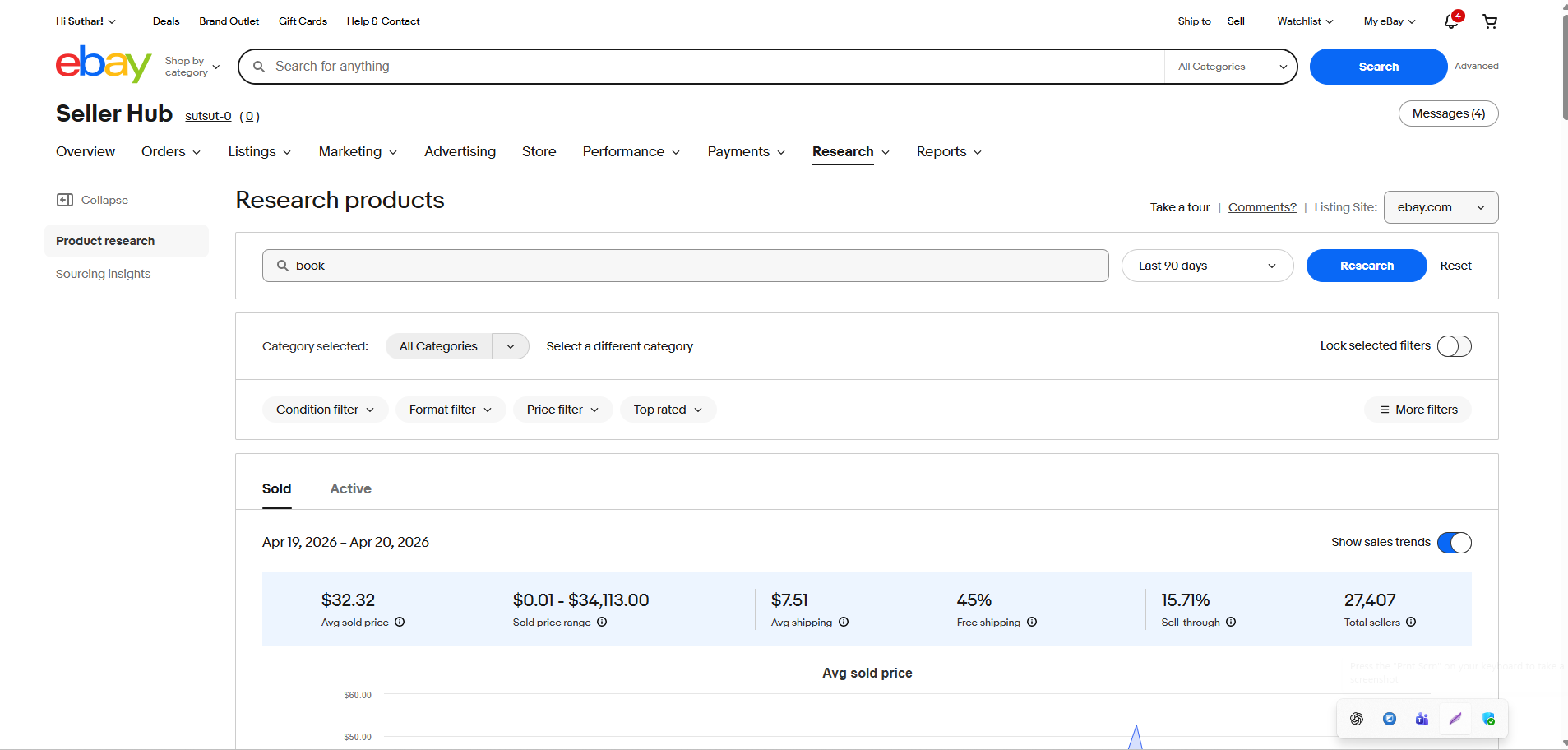
First, log in to eBay Seller Hub. If you do not have an account, register first and get access to Seller Hub. This is where you will start your actual product research.
After logging in, go directly to the Research tab. Here you will find the complete product research section where you can search keywords and analyze market data.
The next step is to enter a keyword. For example, you can search for product keywords like “portable fan”, “phone stand”, or “mini blender”. The goal here is to explore the market, not to find the perfect keyword.
After entering the keyword, the most important step is applying filters. If you do not use filters, your data will not be accurate. Set the date range to the last 30 days so you can see recent performance. Use the price filter to identify a profitable range. Use category and condition filters to remove irrelevant listings.
Now you will have clean data. At this stage, you need to analyze:
- How many sold listings there are
- How many active listings there are
- What the average price is
- Which direction the trend is moving
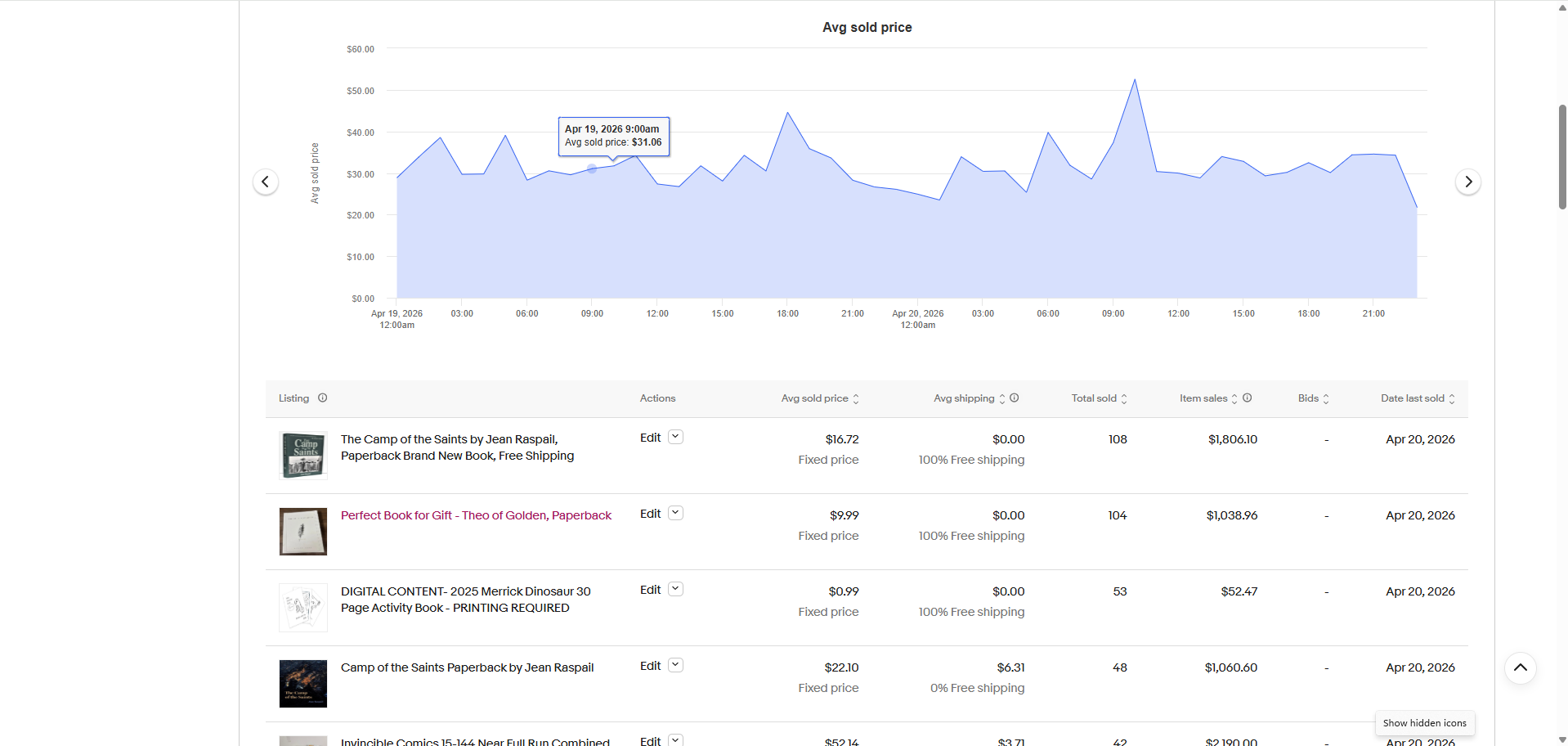
If sold listings are high and active listings are low, the demand is strong. If the price is stable and the trend is not declining, the product can be shortlisted.
This entire workflow may seem simple, but consistency is what matters here. Sellers who follow these exact steps for every product are the ones who see profitable results in the long run.
You can check our Ecommerce Scraper Tool for other platforms data.
Real Case Study (Practical Example)
Now let’s take a real example so you can clearly understand how actual decisions are made.
Product: “Foldable Laptop Table”
When this product was searched in Seller Hub, the following data was found:
- Sold listings: approximately 1400 in the last 30 days
- Active listings: approximately 600
- Average price: $25
- Trend: stable with slight growth
Now let’s break down this data.
First, look at demand. 1400 sold listings means the product is selling regularly. This is a strong signal of demand.
Next, look at competition. 600 active listings means there are sellers, but the market is not saturated. If this number were above 3000, entering would be difficult.
In pricing analysis, the average selling price is $25. If you can source this product at a lower cost, there is a clear margin opportunity.
The trend is stable, which means the product is not seasonal and can sell over the long term.
Final decision: This product is a strong candidate because:
- demand is high
- competition is manageable
- price is profitable
- trend is stable
- You need to repeat this type of analysis for every product.
How to Speed Up Research (Tool Integration)
The biggest challenge is time.
When doing manual research, you have to:
- check each listing individually
- compare multiple searches
- mentally track the data
This process is slow and increases the chances of mistakes.
This is where our ebay seller hub product research tool come in.
Once you set up your research in Seller Hub with keyword search, applied filters, and ready results, you can use a Chrome extension.
The process is simple:
Click on the extension icon
Press the “Start Process” button
After that, the tool helps process the visible data on your screen. It gives you better clarity and allows you to quickly compare which product is performing better.
In the same case study, if you are analyzing “Foldable Laptop Table”:
Manual method:
- you have to open multiple listings
- you need to compare price and sales manually
- time required is 20 to 30 minutes
With the tool:
- data is reviewed quickly
- comparison becomes easy
- decision making becomes faster
These types of tools are commonly searched as eBay seller hub product research tools or eBay seller hub scraper tools because they do not automate the research completely but make the workflow simpler.
The important point is that the tool does not replace your process, it makes it faster and more efficient. You still need to follow the same strategy, but your execution speed and clarity improve.
Global Opportunity Strategy
One of the biggest advantages of eBay is that you can analyze the same product across different countries. Each marketplace behaves differently, demand, pricing, and competition all vary.
For example, a product may be highly competitive in the USA, but it might have lower competition in the UK or Germany. Sometimes the price is also different, which can give you a better margin.
So do not rely on just one marketplace. Check the same keyword across different eBay sites and compare:
- where demand is stable
- where there are fewer sellers
- where the price is better
This approach helps you find hidden opportunities that most sellers miss.
Advanced Insights
If you want to move beyond basic research, you can use some smarter approaches.
The first is niche stacking. Instead of broad products, identify micro niches where competition is naturally lower. For example, instead of “laptop stand”, go for “foldable laptop stand for bed”.
The second is competitor reverse engineering. Analyze top sellers’ stores and see which products they are listing repeatedly. Repeated products indicate consistent performance.
The third is identifying repeatable products. Look for products that sell regularly, not just once. These are important for building stable long term income.
At an advanced level, the focus is on identifying patterns, not picking random products.
Final Product Selection Checklist
Before making the final decision, it is important to do a quick validation. After shortlisting any product, check the following:
- Demand is clear and consistent
- Competition is manageable
- Price range is profitable
- Trend is stable or moving upward
If even one of these feels weak, it is better to skip the product.
Conclusion
Finding winning products is a repeatable process based on data. When you follow structured research and properly validate each step, the chances of success increase significantly.
Over time, you will start identifying patterns and your decision making will become faster. This is the stage where efficiency becomes important, and tools that simplify the research process can be very helpful.
Final mindset is simple:
Do not guess, analyze the data and then make a decision.